
Hempfield Township Previous Residents by Era
The source for previous residents changes with the time period. The county Recorder provides the instrument trail, while the Greensburg-area library collections can show an address or household in selected directory years. Census records give a date-specific household. Township permit material can date a building change but does not name every person who lived there. Keep the property trail and the household trail separate until the parcel, address, and date line up.
| Source | Years it covers | Where held | What it shows |
|---|---|---|---|
| Recorder website | Deeds 1850-present | Recorder DTS Public Access | Recorded party chain and property instruments |
| Recorder historical series | Deed books 1773-1897; grantor/grantee indexes 1773-1900 | State Archives public search room and Recorder | Earlier title chain and index pages |
| Township permits | Issued since 1968 | Planning, Code, or RTKL route | Construction or alteration timing |
| Greensburg directories | Microfilm 1909-intermittent 1959; print 1913 and intermittent 1927-1992 | GHAL Pennsylvania Room | Selected area residence and household evidence |
| Federal census at GHAL | 1790-1870 and 1900-1930 Westmoreland microfilm | GHAL Pennsylvania Room | Household at the enumeration date |
| Hempfield tax assessments | 1786-1843 | State Archives guide | Early taxpayer and property connection |
For a modern address, start with the parcel and current legal description. For a nineteenth-century question, the State Archives chain may be the better opening. The county web description of deeds from 1850 forward describes a web and public-search route, not the first year Westmoreland kept deeds.
Hempfield Township Previous Residents Start With Parcels
Use the Westmoreland County GIS Tax Mapping Site to confirm the physical location before tracing a name. The documented workflow is to accept the terms, proceed to the site, choose Search Parcels, select an alias such as Address, Owner Name, Parcel Number, or UPI Code, enter the search term, and select Hempfield Township in the municipality menu. The highlighted parcel's popup includes the 911 ADDRESS field.
Write down the UPI or map number and the municipality, then use the free Westmoreland Real Property Search for its owner, parcel, or location route. Its tax duplicate refreshes only in late January and late June. The linked GIS ownership card is subscription access, but the separate property search remains a no-cost route. Neither an owner name nor a tax mailing address proves who lived there.
Note: Hempfield Township addresses can have distinct 911, civic, postal, and tax-billing labels for the same structure.
Trace Hempfield Township Previous Residents Through Deeds
After confirming the parcel, use Westmoreland Recorder DTS Public Access to follow the ownership side of the address history. Accept the recorder disclaimer first. Name Search accepts last name, first name, or organization name, with an optional date range. The index is a finding aid, and the Recorder advises searching plausible name variants. Open the deed or its index line and preserve the party roles, recording date, instrument number or Book/Page, document category, and legal description.
- Capture the current owner name and property clues from GIS and Real Property Search.
- Find the current owner's acquisition as a grantee, using a date range or advanced legal fields when they fit the document era.
- Record the grantor, who is usually the prior party to investigate, along with the legal description and placement details.
- Search that grantor's incoming acquisition and repeat backward, comparing lot, subdivision, UPI, or legal description at each link.
- Switch to Book/Page for material before November 13, 2000, and use Archives Search or the State Archives channel for older books and plans.
- Grantor
- The party conveying an interest in a recorded instrument.
- Grantee
- The party receiving that interest. A grantee in one deed may become the grantor in a later transfer.
- Chain of title
- The ordered sequence of recorded property transfers tied by parties and legal description.
- Legal description
- The lot, subdivision, metes, bounds, or similar land identifier that can remain useful when a street label changes.
Hempfield Township Previous Residents Beyond Indexes
Older records require a change of channel, not a conclusion that the property has no earlier history. The Recorder's advanced search may use municipality, UPI, tax-map number, subdivision, lot, category, document type, or consideration, but the county warns that documents do not always contain each field. Tax-map numbers were not required until 2009. A failed UPI or tax-map search is therefore a weak test for an older parcel.
For deeds before the web route is adequate, Westmoreland historical materials include deed books from 1773 through 1897 and grantor-grantee indexes from 1773 through 1900 in the State Archives public search-room collection. The archive also identifies Hempfield Township tax assessments from 1786 through 1843. Call the Recorder before in-person research because the county announced that Copy & Research Center availability had changed to Tuesday and Thursday appointments in a 2025 notice.
The Recorder public-access entry is shown below. Its disclaimer and optional-account screen reinforce that a name result should be checked against the underlying document and the property description.
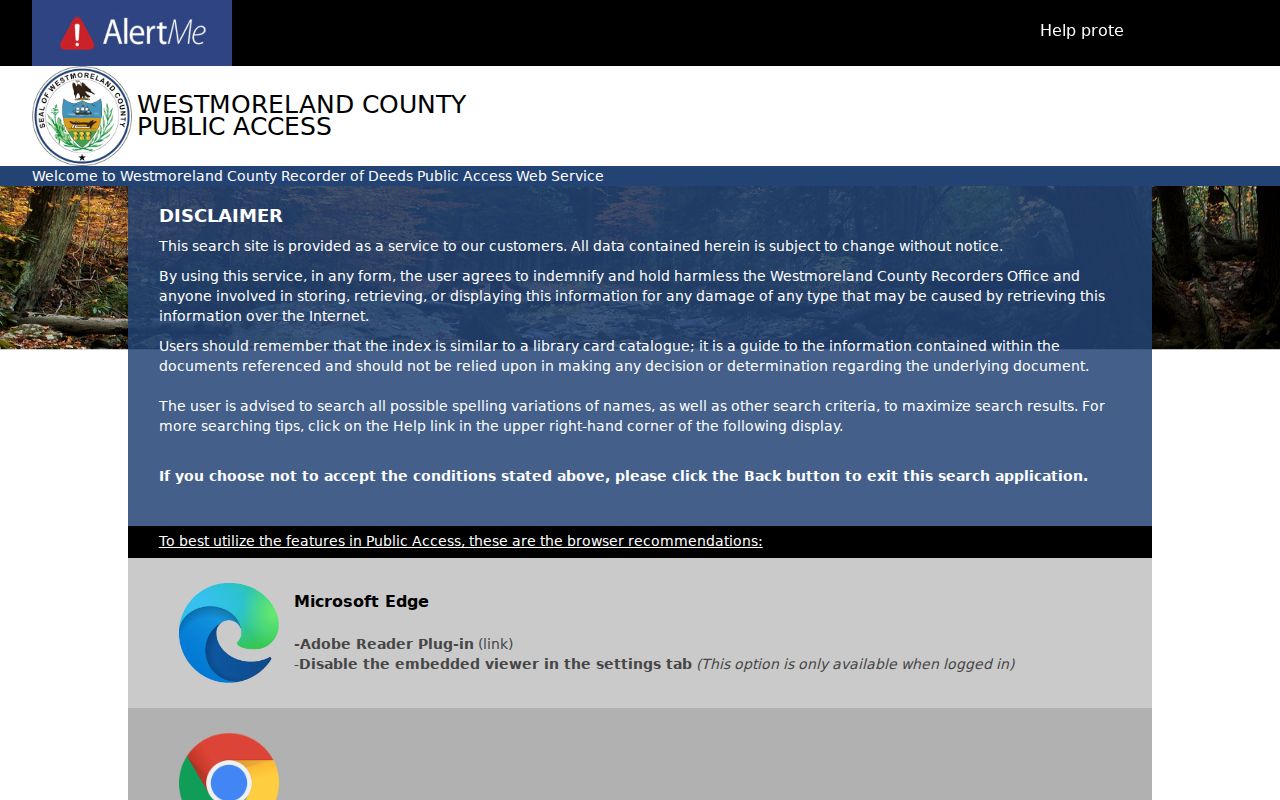
The Recorder screen is an entry point for a deed chain, not a household directory. Estate, trust, corporate, quitclaim, mortgage, sheriff, tax, or name-change records can complicate a simple buyer-to-seller sequence.
Hempfield Township Past Residents: Directories and Census
Previous residents are not limited to former owners. GHAL's Pennsylvania Room holds Greensburg directories on microfilm beginning in 1909, selected printed directories beginning in 1913, and later Greensburg and Latrobe print directories. It also holds Westmoreland census microfilm for 1790-1870 and 1900-1930. Use an address, surname, spouse, or occupation clue to locate a household, then compare the volume date to the nearest census date.
The GHAL Pennsylvania Room source page documents the local-directory, census, and newspaper holdings used in this address workflow. The image below identifies the library route, where stored material is requested for in-library use rather than searched as a complete online address database.
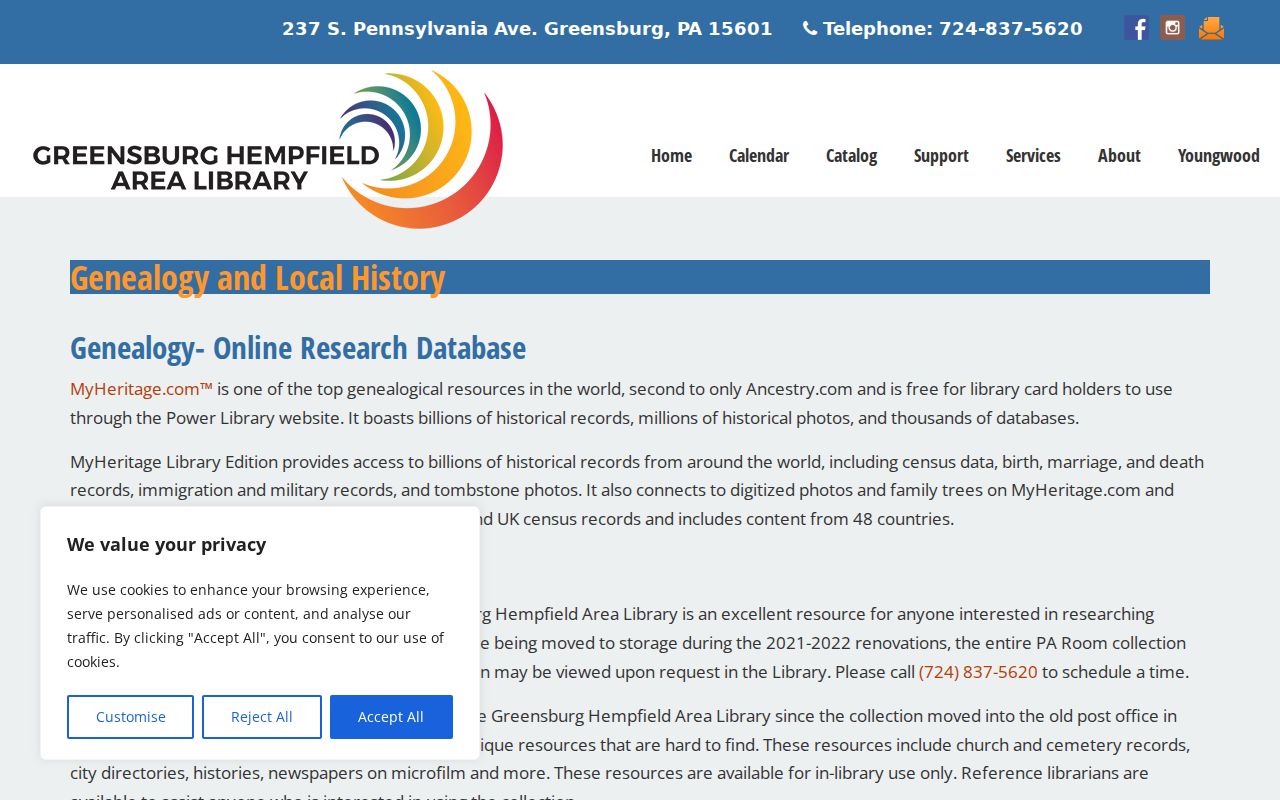
The library collection is most useful when a parcel trail needs a household clue from a particular time, not when a current owner or postal address alone is being treated as proof of occupancy.
- Request the closest directory volume from GHAL and transcribe the edition, page, spelling, and printed address.
- Check the available directory issue before and after it for continuity of initials, spouse, occupation, or address.
- Pair the result with the nearest census available for the period, remembering that 1890 is unavailable because of the federal census fire.
- Use local newspaper microfilm for an obituary, social notice, estate notice, or address notice that can date a move or life event.
- Return to the Register of Wills or Recorder for the primary estate or property document when a notice supplies a useful lead.
The historical shelf itself is described on the Hempfield Township city directories page. For a past-address question, retain only the directory facts that help test the one address and time period at issue.
Lawful personal use. Use Hempfield Township past-resident material for house history, family history, estate research, or personal curiosity. Do not use a record trail to track, harass, or harm any living person.
Hempfield Township Previous Residents and 1890 Gap
The 1890 census loss is a real break in the household record. The digitized 1890-91 Wiggins directory provides a useful local bridge: its title description identifies Greensburg names, occupations, and residences and a separate Hempfield Township taxpayer list with assessed values. A taxpayer listing can support a property connection, but it should not be enlarged into a claim about every occupant.
The Wiggins source screen below establishes the edition and its published scope. Match it to deeds, tax assessments, and contemporary newspapers before adding it to a past-residents timeline.
The key comparison is geographic. Wiggins has Greensburg personal entries and a distinct Hempfield Township taxpayer layer, so a reader must identify which component produced the clue.
Hempfield Township Past Residents at Local Archives
The Greensburg Hempfield Area Library is the first shelf for directories, local census reels, newspapers, church and cemetery records. Its Pennsylvania Room materials are in-library use, and selected stored material is provided on request. If the early surname trail remains unresolved, the Pollins Memorial Library at the Westmoreland County Historical Society offers original documents and family research across the county's historic borders from 1773 onward.
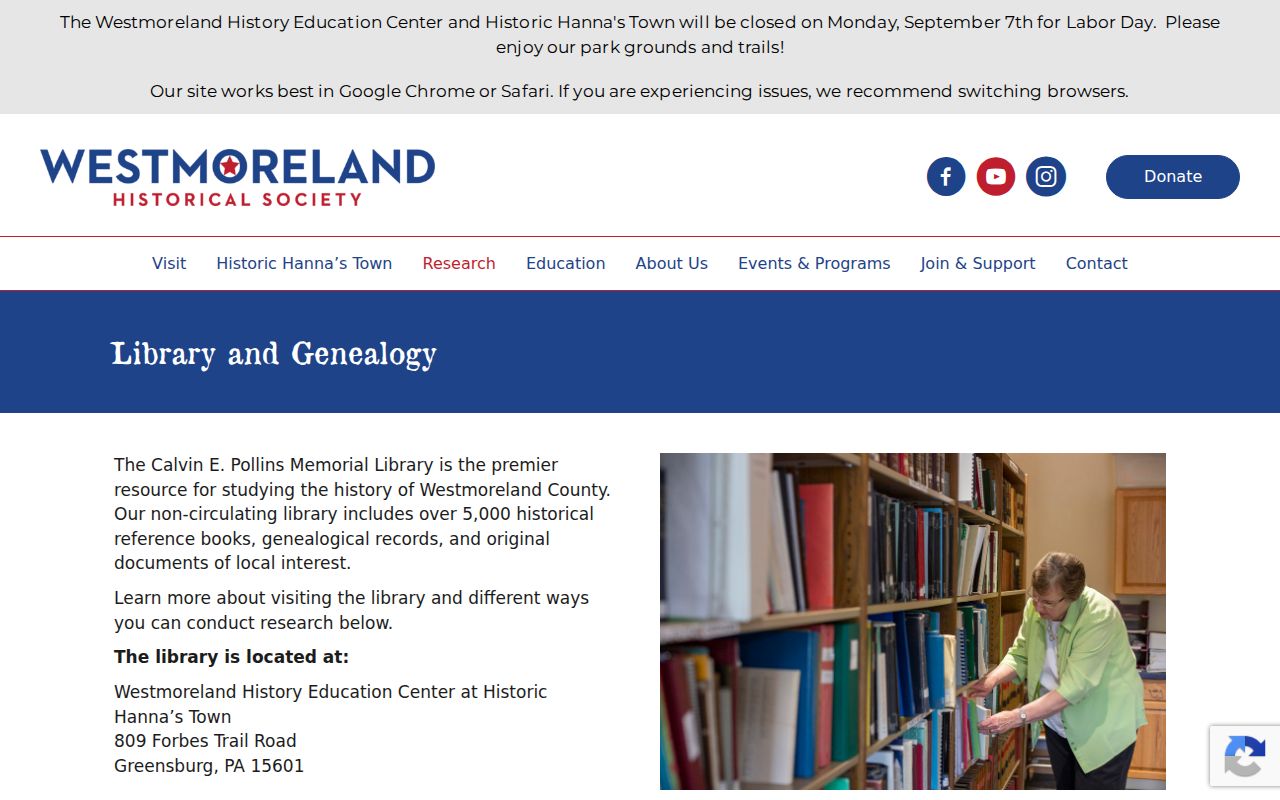
The Pollins Memorial Library page is shown below. Its collection can help with older surname or county-border research, but its listed research service and copy costs should be confirmed directly before requesting work.
For a property inside the mapped Greensburg area, the Library of Congress December 1886 Sanborn sheets may add building and street context. They do not cover the full Township and do not identify all residents.
Hempfield Township Previous Residents and Later Records
Township records can date the physical story of an address. Hempfield says it has issued building permits since 1968, that statewide UCC applied to applications after July 2004, and that it began local UCC enforcement in October 2009. A dated permit, zoning file, variance, or subdivision record can explain construction or alteration. Request the actual file through the Township's Online Service Center or a focused Right-to-Know request because no public historical permit index was found.
Close a historical address trail with an obituary or estate lead when appropriate. Westmoreland's Register of Wills and Clerk of the Orphans' Court maintains estate records dating to 1773, with older research at the office and many later records online. An estate file can identify a representative or other estate facts; it is not proof of current family contacts. This last check helps distinguish a property transfer from a household move.
Note: Never assume an unverified township-wide renumbering year, because the county research did not document one for Hempfield Township.